Recursive Civilization
How systems, feedback loops, and recursive assets build long-term advantage. This is a book about what happens after you save time: whether that surplus disappears, or becomes the seed of a stronger machine.
Build systems that learn.
Get the full Recursive Civilization framework on Payhip.
Saved time usually leaks.
The absorbency trap
You build a template, a checklist, or a script. It saves twenty minutes. Then the minutes vanish into messages, meetings, and someone else's urgency.
The pile problem
Notes, automations, bookmarks, and canned replies can still sit like separate objects. If they do not feed one another, they remain a pile.
The wrong loop
Efficiency can accelerate a bad path. A recursive system needs judgment, boundaries, and a place for surplus to be reinvested.
"An asset that does not re-enter the flow of work is just a polite object waiting to be forgotten."
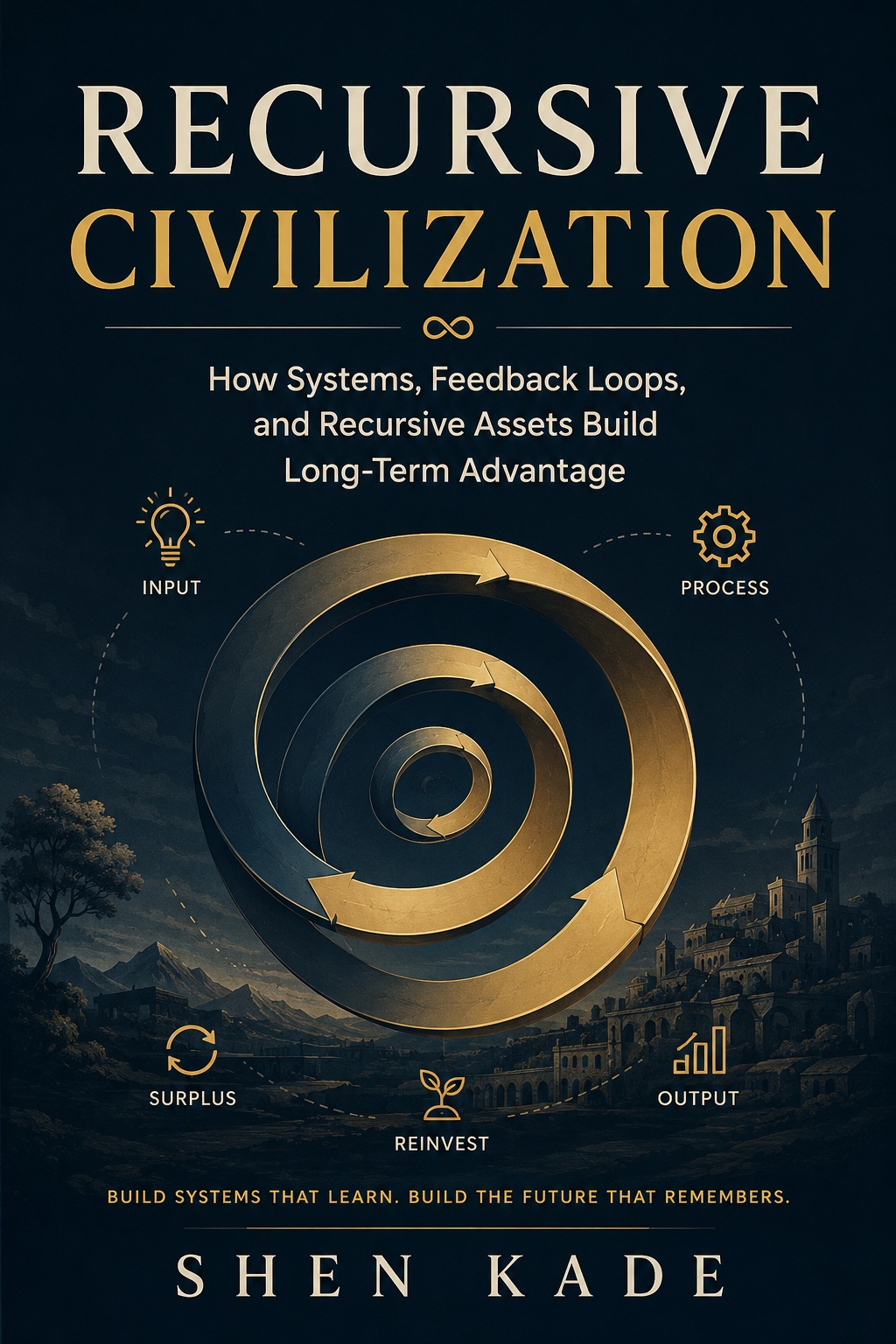
From input to reinvestment.
Input
Capture repeated work, repeated questions, and repeated mistakes without pretending they are random.
Process
Turn the repeat into a method, rule, checklist, interface, or decision surface.
Output
Let the structure produce cleaner work, faster answers, fewer handoffs, or better visibility.
Surplus
Protect the time, attention, and energy released by the asset instead of spending it immediately.
Reinvest
Use the surplus to improve the next asset, expose the next bottleneck, and make the loop easier to run.
A practical architecture.
Operating Manual
A step-by-step way to inventory existing assets, find investable surplus, and map the arrows that force learning from reality.
Resilience And Boundaries
How to avoid zombie loops, shallow metrics, and systems that optimize themselves while making human life worse.
Field Casebooks
Examples from customer service, sales, product, dashboards, and the small places where feedback becomes an advantage.
Stop carrying the relations in your head.
Recursive Civilization is for builders who want assets that do not merely sit there, but feed the next useful thing.