Why I feel stuck at 35 and don't know what to do is the moment when a person discovers that the problem is not a lack of desire. It is an arrangement of incentives, obligations, identity, time, money, and social consequences that keeps producing the same life even after the person has outgrown it.
The quiet signal
The first sign is rarely dramatic. It is not a collapse, a scandal, or a cinematic refusal to continue. It is the smaller feeling that arrives while the life still works. The calendar is full. The income arrives. The role is understood. People know where to find you. From the outside, the structure looks successful enough to defend itself.
That is why why i feel stuck at 35 and don't know what to do is so difficult to name. The person is not failing. They are functioning. They may even be performing well. What changes is not the visible output but the private cost of maintaining it. The life continues to ask for presence, and the person begins to notice that presence is no longer the same as choice.
The root cause is structural
Most advice treats the surface as the cause. It says to be more grateful, more disciplined, more optimistic, or more decisive. The advice may contain a fragment of truth, but it misses the operating system. A person can have courage and still be constrained by school fees, visa rules, debt, family expectations, professional identity, or a single income source that every other decision quietly depends on.
Structural Freedom begins from a different premise: before judging the person, inspect the structure. Ask what the current arrangement rewards. Ask what it punishes. Ask which decision has the easiest logistics. Ask which alternative becomes expensive before it even becomes visible. The answer is often less moral and more mechanical than people expect.
Freedom is not the absence of structure. Freedom is the ability to design your own.
The Hinge Map
The useful framework here is the Hinge Map. A wall is a constraint that cannot move today. A hinge is a constraint that looks fixed until pressure reveals movement. People waste years arguing with walls because walls are obvious. The hinge is usually quieter: a cost that can be reduced, a dependency that can be loosened, a conversation that can be renegotiated, a skill that can travel, a calendar default that can be reclaimed.
What this looks like in real life
Consider the senior professional abroad who says the job is the problem. Then the map becomes specific. The job funds the international school. The company sponsors the visa. The title carries social identity. The salary supports fixed costs sized around the best version of the current structure. The job is not one thing. It is a bundle of dependencies wearing one name.
The first move is not resignation. The first move is decomposition. What part is legal? What part is financial? What part is identity? What part is habit? What part is fear, and what part is accurate risk? Once the bundle is separated, the person can stop asking one impossible question and start moving five smaller hinges.
Common mistakes
The first mistake is escape fantasy. It imagines that a new city, new job, new relationship, or new platform will remove the old structure. Sometimes it helps. Often it relocates the same design. The person leaves the visible cage and rebuilds the invisible one because the assumptions traveled with them.
The second mistake is respectable waiting. Waiting sounds mature because it uses the language of responsibility. Yet waiting becomes dangerous when it produces new reasons to wait faster than old reasons are resolved. A life can spend a decade waiting for the moment when the structure finally permits freedom. Structures rarely volunteer that permission.
A practical audit
Use a one-page audit. List the five claims on your life: income, location, time, identity, and people. Under each one, write what would break if you changed direction in the next ninety days. Then write the smallest repair that would make the break less severe. This is not planning as theater. It is pressure testing the architecture of your life.
For why i feel stuck at 35 and don't know what to do, the important question is not whether you can change everything. You cannot. The question is whether one dependency can be made less absolute. Thirty minutes protected before the day claims it. One cost reduced. One portable asset built. One conversation made honest. One skill documented outside the employer's system. Freedom compounds through small structural changes that survive tired weeks.
The observer's advantage
The person inside a structure usually experiences it as weather. It is just the job, just the mortgage, just the family expectation, just the school calendar, just the market, just the way things are done. The observer learns to see the same facts as design. Design can be studied. Design has load-bearing beams, weak points, defaults, incentives, and maintenance costs. Once the situation becomes design, it stops being fate.
This is why stillness matters. A structure wants you moving quickly enough that you only react to its next demand. Observation slows the demand down. It lets you notice that the urgent email is not only an email. It is a claim on attention. The recurring payment is not only a payment. It is a claim on future choice. The title is not only recognition. It is a story that may be charging rent inside your identity.
What changes first
The first visible change is usually small. A person stops explaining the problem as a private defect. That alone changes the emotional weather. Shame becomes information. Restlessness becomes a signal. Envy becomes a map of disowned desire. Fatigue becomes evidence that the current structure is spending more life than it returns.
The next change is practical. One protected hour becomes two. One unnecessary fixed cost leaves the budget. One dependency at work is documented so someone else can carry it. One conversation becomes less managed and more true. None of this looks heroic from the outside. That is fine. Structural freedom is usually built before anyone else can see the building.
Related ideas
This essay belongs with Why do I feel stuck in life even when everything looks fine, What to do when your life looks perfect from the outside, Why successful people feel the most empty, How to stop feeling trapped when you can't see the exit. Together they form a map of the same underlying question: what part of the life is chosen, and what part is simply inherited structure running on schedule?
For useful external context, read about Wikipedia: systems thinking and Wikipedia: structuralism. These are not authorities on your life. They are reference points for seeing the larger systems around structural freedom, hidden constraints, and life design.
Decision
The decision is simple and not easy: stop asking whether you are allowed to want a different structure. Start asking what the next structure would require, and build the smallest part of it today. Do not confuse slow movement with no movement. The old structure took years to become convincing. The new one earns belief the same way, through repeated proof.
You do not need to blow up your life to begin. You need to see it clearly enough that the next move is not symbolic. The door is rarely locked. It is usually hidden behind dependencies that have never been named with enough precision. Name them. Test the hinges. Build while still inside.
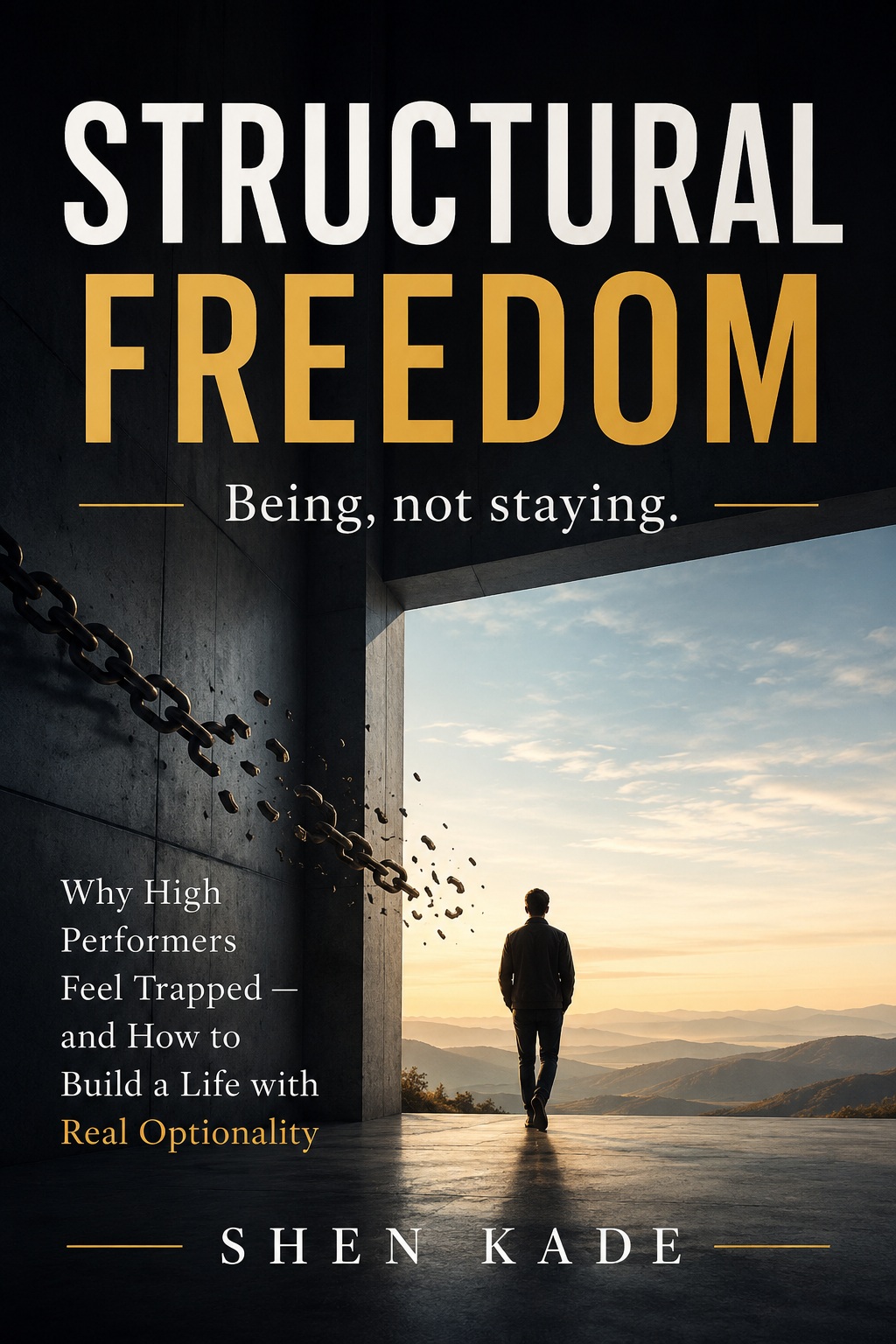
Structural Freedom
You are living inside a structure you never designed. This book shows you how to see it, test the hinges, and redesign a life where presence becomes choice rather than obligation.
Open the Structural Freedom module on /books/ ->